CSA MCQ Reflection
AP CSA Practice Exam 1 – Reflection and Performance Analysis
by Shriya Paladugu
CSA Performance Review
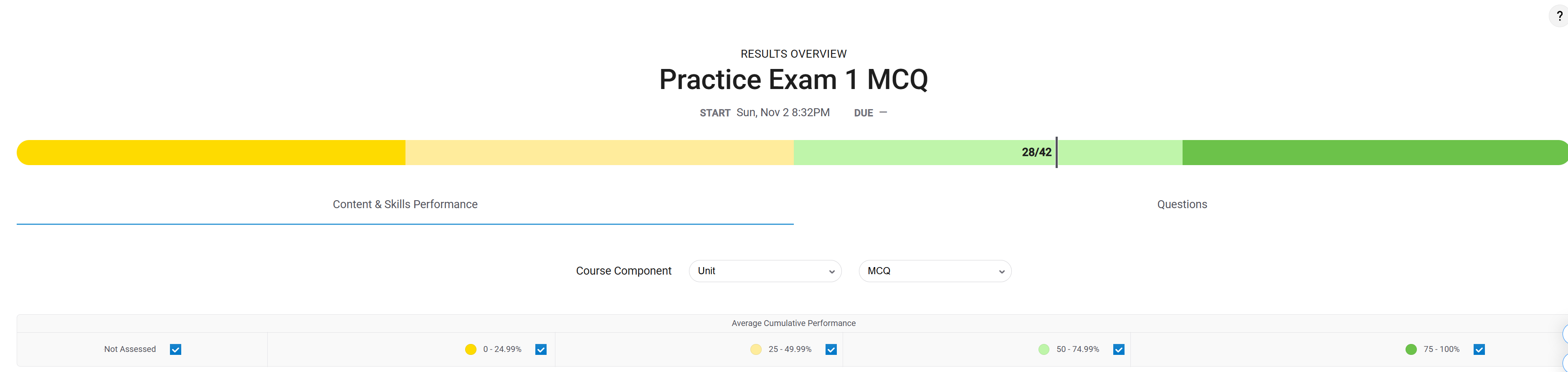
Exam Stats
Total Questions: 42 Correct: 28
Total Time: 1 h 47 m 59 s Average per Question: 2 m 34 s
I. Overview
This practice exam evaluated AP CSA Units 1–4: objects and methods, control flow, class design, and data collections.
My results showed strong fluency in Java fundamentals and class structure, with consistent syntax accuracy.
Most errors came from Unit 4 and Unit 2, especially recursion, 2D array traversal, file parsing, and loop conversion.
Future review will emphasize visualizing logic flow rather than raw memorization.
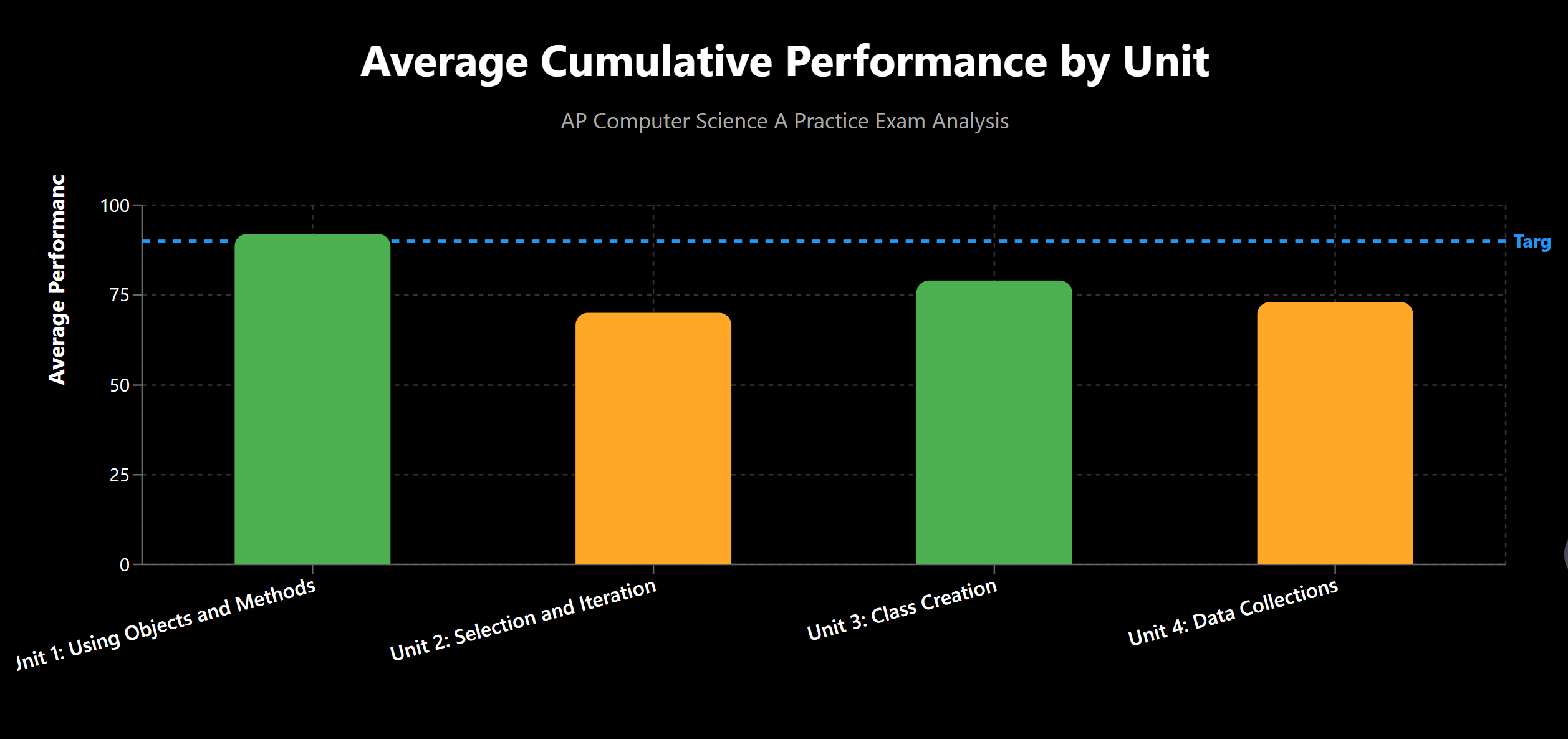
II. Accuracy by Unit
IV. Topic-Level Breakdown
| Question | Topic | AP Unit / Subtopic | Result |
|---|---|---|---|
| Q9 | Private variable access | 3.2 – Encapsulation | Incorrect |
| Q16 | Reliability vs Security | 2.9 – Software Design | Incorrect |
| Q21 | Nested iteration pattern | 4.12 – 2D Arrays | Incorrect |
| Q28 | minOfThree logic | 2.7 – Conditionals | Incorrect |
| Q29 | Recursive printNums method | 4.16 – Recursion | Incorrect |
| Q33 | 2D index modification (r == c) | 4.12 – Iteration | Incorrect |
| Q34 | File reading + split() | 4.6 – Text Processing | Incorrect |
| Q38 | for/while equivalence | 2.8 – Iteration | Incorrect |
| Q40 | Character frequency logic | 4.9 – Loops & Arrays | Incorrect |
| Q42 | Loop translation | 2.8 – Iteration | Incorrect |
V. Deep Analysis and Corrections
Q9 – Private Variable Access
My Approach: Assumed instance variables could be accessed directly anywhere.
Correct Approach: Only class methods can access private fields; outside code must use getters/setters.
Correction: Reinforce encapsulation—state should never be public. This mistake shows I need to review class scope and practice using accessor methods properly.
Q16 – Reliability vs Security
My Approach: Linked reliability with encryption.
Correct Approach: Reliability = consistent functionality; security = protection. Testing under varied conditions improves reliability.
Correction: I confused performance consistency with data safety; understanding this distinction helps in designing more stable programs.
Q21 – Nested Iteration Pattern
My Approach: Reversed both row and column order.
Correct Approach: Only columns reverse; rows stay in order.
for (int r = 0; r < mat.length; r++) {
    for (int c = mat[0].length - 1; c >= 0; c--) {
        result.add(mat[r][c]);
    }
}
Correction: I’ll sketch 2D traversal directions before coding next time to visualize which dimension actually changes.
Q29 – Recursive printNums Method
My Approach: Ignored print placement and recursion order.
Correct Approach: Print happens after recursion (post-order).
Output: -80 40 -20 10
Correction: I’ll trace recursive calls step-by-step to understand stack order and ensure I know whether code executes before or after recursion.
Q33 – 2D Array Diagonal Modification
My Approach: Modified both diagonals.
Correct Approach: Only cells where r == c.
{ {0,0,0},
  {0,1,0},
  {0,0,2},
  {0,0,0} }
Correction: I mixed up diagonal conditions; I’ll test small 2D examples to confirm logic before writing loops.
Q34 – File Reading & String.split()
My Approach: Used two loops for each list.
Correct Approach: Read both values in one loop.
while (sc.hasNext()) {
    String[] temp = sc.next().split("_");
    firstList.add(temp[0]);
    secondList.add(temp[1]);
}
Correction: Combining tasks into a single loop avoids errors and improves efficiency, something I’ll apply to future file-parsing problems.
Q38 – for/while Equivalence
My Approach: Ignored the extra j++ inside the loop.
Correct Approach: Move increment into loop header and adjust bounds.
for (int j = 1; j <= 6; j++) {
    sum += j;
}
Correction: Translating between loops requires matching update steps exactly; I’ll pay attention to where increments occur to prevent off-by-one errors.
VI. Quantitative Trends
| Unit | Questions | Avg Time | Accuracy |
|---|---|---|---|
| 1 | 10 | 1 m 45 s | 90 % |
| 2 | 11 | 2 m 15 s | 65 % |
| 3 | 7 | 2 m 30 s | 78 % |
| 4 | 14 | 2 m 55 s | 60 % |
Observation: Time increased steadily from Units 1–4 as conceptual complexity rose.
Extra time in Unit 4 reflects conceptual struggle rather than pacing.
VII. Strengths & Weaknesses
Strengths
- Confident syntax and logical control flow.
- Strong understanding of constructors and class design.
- Accurate debugging in loop and conditional logic.
Weaknesses
- Visualizing recursive flow and stack behavior.
- 2D array direction logic.
- Scanner and file token parsing.
- Translating while↔for loops without semantic loss.
VIII. Action Plan
| Focus Area | Method | Metric of Mastery | Target Date |
|---|---|---|---|
| Recursion Tracing | Trace 15 examples and verify with IDE | 100 % output match | Nov 10 |
| 2D Traversals | Diagram 10 row/col patterns | Zero direction errors | Nov 12 |
| File Parsing | Practice 5 split() exercises | 100 % list accuracy | Nov 14 |
| Loop Translation | Convert 10 while↔for pairs | No logic change | Nov 16 |
IX. Conclusion
This exam proved that my coding fluency is solid but my conceptual visualization needs polish.
Strengthening recursion and 2D logic will turn these mistakes into automatic successes.
With focused practice on flow tracing and data pattern reasoning, I’m on track for full readiness for the AP CSA exam.